Showing posts with label writing. Show all posts

Tuesday, November 10, 2020

NaNoWriMo: Surviving the Week Two Blues

Week One of NaNo is over, and the Week Two blues have officially commenced. I’ve made really good progress so far (hoping to hit 25k tonight), but I’ve written many of the initial scenes I was really excited about and I’m now well into the meat of the novel. I’m also properly mired in several of the logistical problems I’d been studiously ignoring. Now, it seems, I’ve actually got to do the work of sorting out my plot rather than just playing around with fun scenes. Sigh.

So, when the initial excitement has worn off and the hard work hits, how do we keep going? What are the best ways to beat the Week Two Blues?


1-      Don’t Stress

Firstly, don’t stress if you’re struggling a bit, or your novel doesn’t seem as exciting anymore. This is completely normal! Every writer goes through phases of self-doubt, and the early-middle is one of the hardest parts of a novel. The shine of a new story has worn off, but the end is still nowhere in sight. You now have to confront all the logistical problems you could ignore at the outline stage. This stage of writing is just hard, so don’t feel inferior because you’re struggling.


2-      Take a Walk

If the creative juices aren’t flowing, sometimes the best thing is to get away for a little while. Crucially, you should do something that allows your brain to wander and be creative. Avoid scrolling through social media or watching TV, as these activities take up too much of our attention. Instead, do something to make space for your thoughts, like going for a walk, taking a shower, or doing something artistic. Allowing your mind to wander is crucial for creativity. Pro tip: keep a notepad handy to capture all those brilliant thoughts when they show up!


3-      Spend Time Plotting

If something genuinely isn’t working in your story, it’s worth taking the time to sort it out. Just like tugging harder at a tangled skein of wool only makes it worse, pressing forward with a story that’s broken can just make a mess. Instead, take an hour out to brainstorm solutions. Try using a mindmap, or freewriting (you can even count these words toward your NaNo total, if you want!) You don’t need to do this every time you hit a minor snag, but taking an hour to solve a major problem can make the words flow much faster.


4-      Jump Ahead

If you’re stuck on a section of your story, feel free to jump ahead! There’s no reason why writing has to be linear. Whether you’re wrestling with a stubborn plot hole or just feeling uninspired by a chapter, it’s okay to leave it behind and move on to a more exciting section. Sometimes, moving forward can give you just the energy you need to revitalise your story.


5-      Silence Your Inner Critic

Someday, when you’re sending your novel to beta readers, or agents, or publishers, it might matter if your novel is good. Someday, you might need to turn your most critical eye upon your work. But today, in the middle of NaNo Week Two, is not that day. Today, you write. With NaNo, the only thing that matters is your wordcount. Try “sprints,” where you write as much as you can in a short space of time, perhaps 5 or 20 min. Or, if you’re really stuck, try writing one chapter as badly as you possibly can. It may surprise you just how good your “bad” writing is!


6-      Keep Going

Finally, the most crucial thing of all: keep going! Writing a novel is a marathon, not a sprint. The most important thing is to keep showing up. Even if you’re behind, even if you can only manage 167 words, not 1667, just keep going. It doesn’t matter how small the steps are, as long as you’re moving forward. 


Saturday, October 31, 2020

How to get the most out of NaNoWriMo 2020

With NaNoWriMo starting tomorrow, I decided to dust off this old blog and offer a few tips to potential NaNo-ers. I've done NaNo five times over the past ten years and I've "won" every time, though the novels have certainly varied in their level of quality! This year, I'm working on a new project called THE LIGHTHOUSE KEEPER'S HUSBAND, which is a character-driven fantasy. 

Feel free to connect with me on the NaNo website; I'm always looking for new writing buddies.

But, without further ado, here are my 8 Top Tips for getting the most out of NaNoWriMo 2020.


1) Realise it’s a Sacrifice

Writing 50,000 words isn’t easy. Writing 50,000 words in a month while juggling a million other life responsibilities is even harder. Doing NaNo will require at least an hour or two every day, and that time has got to come from somewhere. Whether you chose to watch less TV, spend less time with friends, or let your house get a little messy, something has to give. The good thing is, that’s okay! While you probably shouldn’t ignore your family for a month, you don’t need to feel guilty about cooking a frozen pizza or ordering takeout. Writing is your priority this month, and that’s okay.


2) Schedule Writing Time

Winning NaNo is all about developing a writing habit, so it helps if you establish a set time to write. This won’t be possible for everyone, but most people can set aside a few minutes in a relatively regular pattern. I try to do about 45 minutes before starting work in the morning, and then another 45 minutes just before bed. If I use those minutes well, I can generally just about hit my wordcount in those times, then catch up a little on the weekend.


3) Catch Up

When starting out with NaNo, the number 1667 can loom large in our minds. It’s definitely helpful to develop a consistent writing schedule, but it’s also okay if you don’t hit 1667 every day. The past few years I’ve had really bad starts, with only a few hundred words over the first few days. This may seem disastrous (“I’m already 5000 words behind!”) but over the course of a month, it’s easy to catch up. Just do an extra 15 minutes here and there, or schedule some focussed time on the weekend. A bad start doesn’t have to be the end of your NaNo goal!


4) Make a Playlist

There’s nothing that gets you in the mood for writing like a good playlist. While some enterprising writers take the time to curate a playlist for each book, I adopt the much lazier approach of simply choosing an album to listen to on repeat. I find the best kind of writing music is where the lyrics aren’t really that important, and the songs all sound essentially the same. Previous favourites include Maroon 5’s singles, anything by Bastille, and Ed Sheeran’s early albums (don’t judge).


5) No Editing

This tip is on pretty much every NaNo advice blog there is, and for good reason. Not only is editing a waste of time during NaNo (if it doesn’t add to your wordcount, don’t do it!) but editing also makes you more critical of your work, which totally defeats the point. The beauty of NaNo is that you get to turn off your inner critic and just write, so avoid the temptation to edit, and focus on your wordcount instead!


6) Avoid the Blank Page

Have you ever found yourself poised at your keyboard, a fresh document in front of you, the cursor blinking mockingly as you try to think of how to start? It may sound exciting to begin a whole new project, but staring at a blank page is a sure-fire route to the dreaded writer’s block. If you don’t have the perfect opening line for your novel yet, don’t worry! Just start with whatever you’ve got, and fill in the rest later. There’s nothing that says you have to write your novel in order! You can even write “ADD BRILLIANT FIRST LINE HERE,” to remind you to revisit the opening in December.


7) Measure Your Progress

Watching your wordcount rise is a powerful motivator. The NaNo website lets you enter your wordcount every day and provides all sorts of helpful statistics—you can even track your mood! I’ve also made my own spreadsheet that tracks my wordcount, the words remaining, how far I am ahead/behind target, my average wordcount per day, and the average wordcount I need each day to finish on time. It took a little work to figure out Excel, but having detailed statistics helps keep me motivated. If it would help you, feel free to download my spreadsheet template.


8) Remember Why

It might sound cheesy, but on those stressful nights when it’s midnight and you’ve got to work tomorrow and you’re coming down with a cold but you still haven’t hit your wordcount goal… it’s important to remember why you’re doing it. Do you want to “win” NaNo, or just push yourself a bit? If you’re determined to win, why? Are you desperate to tell your story? Do you want to prove you have what it takes to be a writer? Or do you just not like giving up? In the depths of November, it’s important to remember that “winning” doesn’t actually earn you anything (other than a fun badge and maybe a T-shirt). Hitting 50K feels great, but focussing on your personal goals helps you get the most out of NaNo. 


Did you find these tips helpful? Add your own in the comments below-- I'd love to hear from you!


Monday, September 18, 2017

On First Drafts, Editing, and the Real Work of Writing


“The first draft of anything is shit.”
--- Ernest Hemingway

A lecturer at St. Andrews has this quote hanging on her office door, as if challenging all the complacent undergraduates waiting in the hallway. I always found it vaguely encouraging, as much as anything by Hemingway could be encouraging. Maybe the chapter draft I just sent to my supervisor wasn’t all that great, but that’s fine. It’s a draft. It’ll get better.

I’ve never minded the idea of writing a bad first draft. I love things like NaNo, where you just write without worrying if it’s any good. I’m not a perfectionist, and the process of actually getting words down on paper has always been relatively easy for me.

But I’ve never been good at actually doing anything with those words. I’ve written five novels, and none of them have ever made it past a first draft. I’ve never actually polished anything until it was as good as I could make it.

With four of these novels, I know I made the right choice to move on. The first one was essentially a Tolkien fan-fic. The second was a mystery with plot holes as wide as the Northumberland Strait. The third was an international thriller with even larger plot holes and a rather dubious treatment of terrorism. The fourth was a YA dystopian, written just before Divergent was published and unfortunately left unfinished before the dystopian bubble burst. I learned so much from writing each of these novels, but none of them were worth polishing.

And then, after a six-year hiatus, NaNo 2016 produced my fifth novel, a futuristic retelling of Shakespeare’s Richard II. I wrote 119,053 words in 68 days, and then returned to real life (or, y’know, writing a PhD.)

The difficulty with this novel is that, nearly a year later, I still think it’s good. I still love the characters. I love the story. I even love the writing (some of the time…). For the first time, there are no major flaws.

But that’s the problem. For the first time, I have no choice but to actual return to my novel and edit it. I can’t just stick it in a drawer and write a new novel. I’ve got to actually edit this one.

That’s certainly not going to be easy. As much as I love it, I know the story has significant issues. The world needs to be more developed. The themes need to be more subtle. The emotional arc needs to be polished. Relationships between characters need to be clarified. Certain scenes should be added, others cut.

I’ve written five novels. I know how to hammer out a story in a few weeks. But I have no clue how to polish it. On a practical level, I literally don’t know how to begin.

But also, on an emotional level, I’m scared to start editing. Because once I start to polish my novel, then I’ll really know if it’s any good. Then I’ll know if I’m actually any good.

If Hemingway was right, if the first draft of anything is shit, then that means that the real work of writing isn’t in getting words down on paper. It’s not writing 119,053 words in 68 days. If Hemingway was right, then the real work of writing comes in taking those rubbish words and making them shine. And that’s something I’ve never done.

There’s a strange sort of comfort in not trying. The world is full of people who think they could write a novel, and they’ll keep saying that until they try and fail. I think I can edit a book, and get an agent, and a publisher… and I’ll be able to keep thinking that until I try and fail.

I don’t really think I’ll fail, not ultimately. I believe that with enough hard work, I’ll eventually produce something good enough to be published. But I can’t say that I’m not scared of all the rejection that’s undoubtedly going to come. The books I’ll try to edit only to find they’re really not good enough. The agents who’ll send form rejection emails. The publishers who pass. The readers who write bad reviews.

Right now I can call myself a writer and not have to face any of that failure. Except, to keep calling myself a writer, I need to keep moving forward. I need to move beyond what I’m comfortable with and start doing what scares me.

I need to start turning my gargantuan first draft into something worth reading.

Let’s see how this goes. 

Thursday, October 3, 2013

Day 31: One Month!

A month ago today, to the hour in fact (and I mean the hour that I’m writing this, not posting it, because, you know, editing takes time), I arrived in St. Andrew’s.

It’s been a whirlwind ride. Life is only now finally fitting itself into a routine, and, for better or for worse, that routine actually involves a lot of school work. The first few weeks were like a vacation, but now I spend most of my time in my room hunched over a book. Things should get better in a few weeks, though, once my two major essays are handed in and I’ve written the Old English Vocabulary test.
 
(Old English Word of the Day: anfloga means “solitary flyer” and its only recorded use is in an elegy known as “The Seafarer.” I’m not quite sure why I love this word so much, but I think it’s because its flowing sound captures both the sadness and beauty of being alone.)

I realized the other day that being here for one month means that I have already lived through a 9th of my time in Scotland. Now, I know that a 9th isn’t exactly a huge fraction, but it is a substantial chunk. I’m not a complete newbie anymore… and I don’t have unlimited time ahead of me.
 
I don’t think too much about how many days I have left, though, because I simply don’t have the time to mope about how my time here won’t last forever. Aside from school work, I’ve settled on these activities:


Christian meetings such as bible studies, worship nights, and prayer meetings happen nearly every day. The Christian community here has just been so welcoming and kind that I felt right at home from day one. Definitely an answer to prayer! The Christian Union also lets me get a little more involved in giving back to the town, by volunteering at Toastie bar (which sells 50p toasties and donates the proceeds to charity) or doing yard work for elderly neighbours.
 
Performing Arts are also a huge part of my life here. While I’ve had to drop my dance class due to a scheduling conflict (sadness…), I landed a lead-chorus role in the Gilbert and Sullivan Society’s Iolanthe, which rehearses twice a week until the show in mid-November. I’m also co-directing (and possibly teching) one of the Freshers Plays (plays put on entirely by Freshers), and auditions for that start next week. Finally, the St. Andrew’s choir, with over 150 members, is singing Handel’s Messiah this year, so I’m considering joining.

I’ve been trying to write a bit, by keeping this blog going and writing for the student newspapers of both St. Andrew’s and King’s back in Canada. The creative writing society, Inklight, frequently hosts workshops, which I attend whenever possible. A couple people I’ve met are also into writing, so we’re trying to encourage each other and might end up collaborating on a play, if we can get our act together (no pun intended).

Getting so involved in St. Andrews has made me realize just how silly it was of me not to be more active in student life back home. I may have had an excuse—the school workload was definitely heavier—but I missed out on so much by not auditioning for plays or going to writing workshops or volunteering or joining Campus for Christ. Academics were definitely a priority, but there was so much more I could have done at Western. And now I’ll never get the chance…
 
Well, then. No use moping over a couple partly wasted years. Time to stop blogging and head out to paint the elderly neighbour’s fence, then off to Iolanthe read-through, and then Bible study…

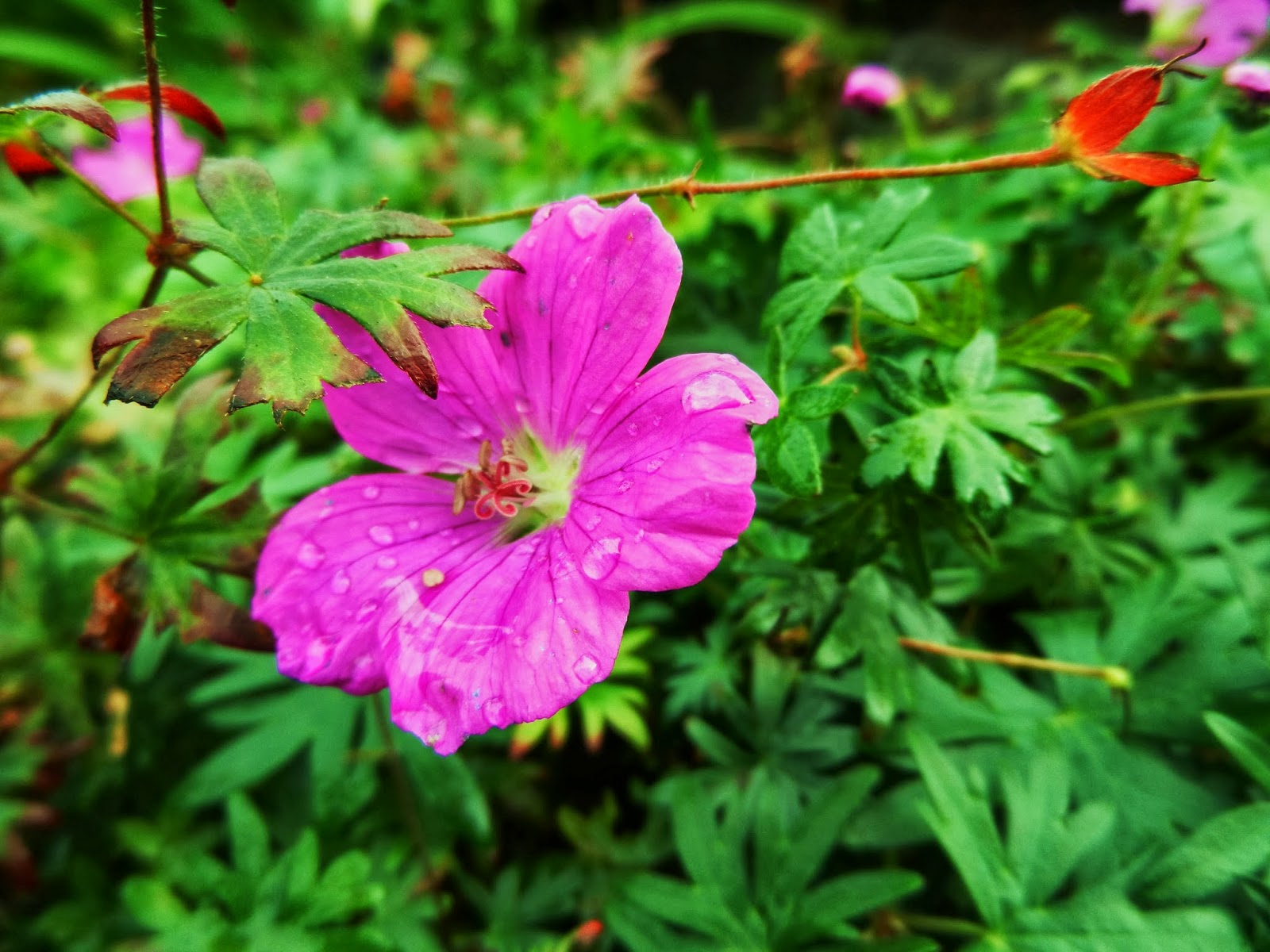
(NOTE: The random flower pictures are from an afternoon when Kayla (one of the other Canadian exchange students) and I visited the Botanical Gardens and I went a little crazy with the macro setting on my camera.)


Monday, July 22, 2013

What Writers Can Learn from S. J. Kincaid's "Insignia"

I plucked S. J. Kincaid’s Insignia off the library shelf randomly the other day, was enticed by Veronica Roth’s blurb and the fact that it was published by Harper Collins’ imprint Katherine Tegan, and then proceeded to devour it in a few days (which is fast, considering that I’m working full time).

According to her blog, Kincaid apparently wrote something like eight novels before finding a publisher for Insignia. There’s always something a little sad about trunked novels, but with Insignia all the experience definitely paid off. It has the freshness and unassuming tone of a first novel, but with the structure of a bestseller, which I really hope it was.

Firstly, I loved the opening line: New town, new casino—same old plan.

I love this because it’s so perfectly concise. We have seven words—seven—and we understand exactly what Tom’s life has been like and what it seems like it’ll continue to be. Kincaid didn’t need to go on for a few paragraphs about how Tom journeyed from casino to casino, beating people in the Virtual Reality parlours. Instead, she gives us one fantastic sentence and then shows us, in a well constructed scene, the sort of life Tom leads.

The entire novel fits together like a puzzle. Every scene has a point. There’s always something to be gained or lost. There were never any extra details that just sorta got left behind.

That was the most impressive bit: everything tied in with everything else. Little details at the beginning of the story ended up relating to major plot points near the end. Certain scenes that seemed a little useless early on became necessary to later scenes. Eventually, whenever something seemed to be a little extra, I started watching for it to crop up again, and it always did.


All in all, I loved Insignia for its characters, and its plot, and its ideas, but I was most impressed by Kincaid’s structure. I’d definitely recommend the book to any sci-fi/dystopian fans, and to any YA writers in general who want to create intricate and interconnecting plot lines.


Tuesday, July 16, 2013

Summer Goals: An Update

So. About three weeks ago I wrote a lovely little post about my summer goals, full of optimism and hope for a productive summer. Now, over a quarter of the way into my vacation, it’s time to ‘fess up to what I haven’t accomplished… and maybe celebrate a little about what I have.

The most obvious goal I haven’t met is that I definitely haven’t been blogging twice a week. I’ve got a number of excuses (poor internet connection, over-enthusiastic inner editor, lack of time, etc….) but the fact remains that this is only the fourth blog post in three weeks, so I’m a few behind. I’ve decided to start publishing my backlog of book reviews twice a week, so at least that will be something, and I’ve got another couple ideas for posts on writing. Basically, I can almost guarantee that this blog will see more activity in the coming weeks.

Secondly, I definitely haven’t been writing as much as I wanted. For the first week, my 15-minutes-a-day goal worked wonderfully, but when Saturday hit and I was nowhere near my 5 hours for the week, discouragement hit and I haven’t written since. I definitely need to find a better way to get myself writing, since I have a few projects that I would love to work on. It’s just so difficult to get in the writing groove after coming home from work.

But, enough with the negativity. My PEI goals have been coming along nicely; I’ve already seen three shows and discovered an awesome beach I didn’t know existed. I’ve also visited several old favourite places of mine, like Canoe Cove beach, Brackley beach, and Avonlea village. The weather here has been wonderful recently, and I’ve spent a lot of time swimming and lying on sand pretending to tan.

Finally, my reading projects have been going well. I’ve finished three Shakespeare plays and am halfway through a fourth, (Coriolanus, Richard II,  A Winter’s Tale, and Henry IV) and I’ve read a number of YA novels (Entwined, Ophelia, The Power of Six, Looking for Alaska, Hate List, Never Have I Ever, Two Truths and a Lie, and Insignia). What’s wonderful is that I’ve really enjoyed all the novels I read and have found a few new favourites (which I’ll be blogging about soon).


In short, I’m feeling a little down that my writing goals haven’t really helped me to actually write, but everything else is going to plan. And, most of all, I’m enjoying my summer, and that’s what really counts. 


Saturday, July 6, 2013

The Wonders of Non-Fiction

One of the most wonderful things about working in a library is that I’m surrounded by hundreds of books. Conversely, one of the worst things is that I’m surrounded by hundreds of books. Shelving definitely takes a lot longer when you’re constantly stopping to read a back cover or the inside flap.

Sometimes, I can pass this lollygagging off as work. If I stop to read a children’s book, for instance, I can say that I’m just looking for good books for kids’ story time. Or, if I take a good look at a YA novel, I’m ‘researching’ so I can make better recommendations when someone comes in looking for a book.

Today, though, I got a little sidetracked in the non-fiction section. Normally, I tend to think of non-fiction as being sort of dull, just the bare facts. Today, though, there were all sorts of interesting books. There were author biographies, Tolkien’s essays on Norse mythology, true crime, a man who went a year without money, how autistic children relate to animals, and my personal favourite, How to Avoid being Killed in a War Zone (no, that’s not a joke. It’s a legit book for people travelling to war zones).

As fiction writers, I think we should be reading non-fiction just as much as fiction. There’s nothing like reading a book on schizophrenia to help you write about a character with mental illness. If your main character is an actress, read a book about audition prep. If you’re writing an international thriller, read about how to avoid being killed in a war zone.

So often, if we only read fiction, we tend to see the world as authors represent it, not as it really is. Now, I’m not trying to suggest that authors don’t do their research, since many spend ridiculous amounts of time checking their facts, but their books still are works of fiction. So, when we write, instead of imitating life, our novels become imitations of other novels, effectively imitating the imitators.

Non-fiction books are your primary sources. They can give you facts, ideas, or provide little details to make your story more realistic. They present real thoughts and emotions, not just an artist’s representation. A memoir of a genocide survivor will tell you exactly how they felt when their family was murdered, not just how an author imagines people would feel.


Non-fiction has a sort of ruggedness that fiction tries to reach, but never quite can. As good as an author is, they can never really break through the reader’s knowledge that the book is simply a work of fiction. With non-fiction, there is no wall. The reader doesn’t have to suspend their disbelief, because everything is supposed to be believed. There’s something so really real about non-fiction that we as fiction writers should learn from. 


Monday, June 24, 2013

Summer Goals

One of the wonderful things about being home for the summer is that I can finally actually get some reading and writing done. I read Entwined (by Heather Dixon) the other day, and it was the first YA novel I’d read in nearly a year. I also read Shakespeare’s Coriolanus (because Tom Hiddleston is performing in the title role this fall in London) Maybe it’s silly to read another classic, just like what I’ve been studying at university all year, but it’s still nice to read it for personal pleasure, rather than for a class.

With eleven weeks of summer ahead of me, I’ve decided to set some goals to make the most out of my PEI vacation. I’ll be working full time at the library and hanging out with friends, but that should still leave time for plenty of reading, writing, and enjoying what PEI has to offer.

To make sure I don’t spend the summer on Facebook, I’ve set some SMART goals under the general headings of Reading, Writing, and PEI. You possibly know that SMART stands for Specific, Measurable, Attainable, Realistic, and Timely, and I find the acronym helpful for setting goals that actually have a chance of getting completed.

Under Reading, my goals are very simple. I’d like to read ten Shakespeare plays (and watch the film versions) and at least fifteen YA novels. I’ll likely read more than this, but with a relatively low goal I know I won’t end up spending the last week of August frantically reading ten novels simply to meet an arbitrary limit.

Beyond excited for this play!
Writing goals were a little more difficult to define. I have two major projects I’m working on (a novel and a play) and while I’d love to finish them both, I doubt I’ll have the time in just two months. Writing is also dangerous to measure by output, especially since I’ve never written a play before and I have no idea what sort of speed I can expect. So, I’ve decided to measure my writing goals by time, spending five hours a week, with at least fifteen minutes a day. I’ll also write book reviews for every novel I read and blog twice a week, which doesn’t count under this time limit.

Finally, since this may be the last summer I spend at home, I’ve decided to take advantage of what PEI has to offer. There’s an amazing theatre community here, so I’ve made up my mind to see at least five shows, whether that be a professional musical like Anne of Green Gables, or a smaller comedy my friends are starring in. I also want to visit two places (beaches, hiking trails, tourist sites) that I’ve never visited before, because even though I’ve lived here for seventeen years there are so many places I’ve never seen.

Those are my goals for the summer. Hopefully they’re all SMART, and I’ll actually end up reaching them. It would be refreshing to look back at the end of the summer and see how much I’ve accomplished.

Now, over to you. What are your summer goals? How do you plan to reach them?


Saturday, June 22, 2013

A New Direction

With my Quebec City adventure over, and Scotland still two and a half months away, it seems like this blog will have to stop chronicling my exploits and revert back to what it’s actually supposed to be: a blog on writing.

My posts will be a little different than the generic how-to-write-YA instructions that I used to write in previous years. Since so many authors are blogging on topics like how-to-create-fascinating-characters, or how-to-fix-a-horrible-first-draft, or the all important how-to-make-your-hero-swoon-worthy, I’ve decided to bow out of that scene. As an unpublished author, I feel like it’s better to leave the how-to posts to the pros.

I’ve decided instead to write more general, slightly theoretical posts. I’d like to take certain novels and dissect them a little, talking about what worked or what didn’t. I’d like to write some slightly more comprehensive book reviews, talking more about what the novels are really saying. Finally, I want to examine some key stories that YA isn’t telling, and deconstruct some of YA’s central conventions.

Don’t worry, though. When I say “theoretical,” I don’t mean Deridean abstract philosophy on the meaning of the sign and the signifier, or any of that fun stuff. I simply want to take some of the critical thinking skills that I regularly apply to literature in English class, and instead relate them to YA novels. I’ll try and make my posts as practical as possible to your daily writing life.

This summer I may also have a few my-life posts, since life on PEI is basically an adventure in itself. However, the real fun waits until September, when I fly out to Scotland. With just around 11 weeks until I leave, things are starting to fall into place, but there’s still a lot left to do (*coughVISAcough*). For now, though, the main purpose of this blog will actually be writing.


Monday, April 15, 2013

A Double Life


“I hope you have not been leading a double life, pretending to be wicked but really being good all the time. That would be hypocrisy.”
                ---- Oscar Wilde, The Importance of Being Earnest

I lead a double life.

This may not seem surprising. After all, what writer doesn’t? Except for those fortunate few who can afford to make writing their careers, we all have to put down our pens (or shut our laptops) and get on with the normal business of working, parenting, or school.

For me, though, even my writing has fractured. Online, most of you know me as part of the YA literature scene. I write YA, blog about YA, and write reviews of YA novels. However, in “real” life, most people know me as the straight-A student who loves reading Shakespeare or Milton in her free time and has plans to do her PhD and be a professor. Those people are shocked that someone who reads The Wasteland for fun, or who can recite Yeats from memory would also have a shelf full of YA novels.

People normally see “high brow” and “low brow” literature as completely separate. They don’t think that Joyce’s Ulysses and Twilight could have anything in common.

Wait.

Did I just suggest that one of the greatest novels in the English language is somehow similar to a teen vampire story?

Yes. Yes I did. While there are many differences between the two, they are, fundamentally, about what it means to be human. Leopold Bloom wanders aimlessly around Dublin, and Bella Swan falls in love with a sparkling vampire, but both are ordinary humans seeking fulfillment. Well-written or not, “teen trash” or highly literary, entertaining or tedious, these stories tell us something about the human condition.

For me, that’s the point of any and all literature. To reach out to other humans, to overcome, as Joseph Conrad would say, “the loneliness of innumerable hearts,” and to truly communicate with someone else.

That is why I can’t find any disconnect between my scholarly studies and my YA writing. Because whether I’m reading The Hunger Games or Beowulf, Paranormalcy or Pride and Prejudice, J. K. Rowling or Virginia Woolf, I’m still reading about fundamental human issues. The need to be loved. To have faith. To belong.

The style may be different. Yes, some styles may even be “better” (but that’s a completely different argument). But, at the core, they are the same.

That is why I can be both 100% YA author and 100% academic. Because I am also 100% a writer. 


Friday, May 4, 2012

Dust it Off Bloghop-- Pitch

For the first day in the Dust it Off Bloghop (which was supposed to begin yesterday, but I'm a bit late), I'm going to post the short pitch for my 2010 NaNo novel, WANDER.

If he wanted you dead, you'd be dead by now.
He wants you alive.
He wants you to fail.


While I do sort of like this pitch, in that it's short and creepy and hopefully somewhat enticing, I think it encapsulates exactly what was wrong with the novel. Frankly, WANDER was too confusing. The reader doesn't even know about this mysterious 'he' until near the end of the first book. No one knows exactly why he wants them to fail until near the end of the third book. While mystery is good, in this case there was just too much that didn't really make sense and seemed unrealistic. The end of the third book brought everything together, but most readers aren't going to wait that long.

I have another version of the short pitch:

Ida and Wander have been best friends for a month now. The strange thing is, they've never met. When the internet-pals decide to finally meet via webcam, Wander is kidnapped and Ida is threatened with the same fate if she tells the police.


This pitch has the same problem. As the reader quickly learns, Wander doesn't really get kidnapped; it's a lot more complicated with that. The thing is, the plot of the story is far too confusing to try and describe in a short pitch. And if the story is that confusing, it's probably going to be too confusing for the reader to follow.

So, there's day one of the Dust it Off Bloghop. It's making me a little sad to take out WANDER and criticize it like this; after all, it was the first novel I ever completed solo. I do still love the characters and the plot (despite its many flaws) so it's kind of sad to treat it as nothing more than a learning experience. However, that is one of the wonderful things about being a writer. Maybe no one else will ever get to learn about Wander and Ida and Ephraim and all my other characters... but they'll always be in my heart (no matter how cheesy that sounds).


Friday, December 2, 2011

Find the Right Agent

 I know that one thing you should never, ever do on your blog is talk about your dream agent. After all, what happens if you query an agent other than her, who then reads your blog and realizes that you’d actually much rather have someone else? For that reason, I’m not going to talk about dream agents. I just want to talk about agents in general to get at the big question: what do you look for in an agent?

I know for unagented authors, sometimes it can seem like just getting any agent at all is a huge thing, so you don’t really care which one. Some days I feel like this: I just really want an agent. But on other days, when I’m being sensible, I realize that I’m young, and finding the right agent who’ll work with me for the rest of my career is going to be really important.

Here are a couple things that I really want in an agent:

- They should be hands-on. I want an editorial agent. I want them to care about helping me make my book as good as it can possibly be.
- They should share my values. This means that I don’t want an agent who reps erotica, or who mainly reps paranormal, or who wants me to amp up the sexual content in my stories. They don’t need to be Christian, but I want them to accept the religious views in my stories.
- I want to get to know their other clients. I want some of their other clients to be ones who I respect; I’ve read their stories and I’ll be proud to be connected to them through the agency.
- They should sell to big presses. Now, I don’t mean exclusively or anything, but it’s my dream to sell to one of the big six, so even if I don’t get there right away, I want that possibility.

Those are all of them that I can think of off the top of my head. Now, how do I find out whether an agent fits these criteria?

- Follow them on twitter. If an agent is hands-on, they’ll mention stuff about editing client manuscripts, or they might outright call themselves editorial in a twitter chat.
- Follow their blog. Their values will come out that way; I probably don’t want an agent who swears a lot. Also, someone who has a lot of sketchy book covers at the side of their page… nuh uh.
- Read the acknowledgements sections of my favourite books and see who their agents are. Look at the lists of authors on the website; if I don’t recognize any, I’ll normally forget about the agency.
- Go to their website and look at the list of books to see if I recognize any (I mainly read books from big presses). Check out their recent sales and look up the books to find a publisher.

These four suggestions are great ways to get to know agents to see if you really want them to represent you. There are lots of great agents out there who are amazing at what they do, but just not right for me. I’m not saying you should be too choosy, but it does pay to do your research.

Over to you, my readers. How is your Great Agent Hunt going? Any tips for finding agents to query? What do you look for in an agent? 

Wednesday, November 16, 2011

Cut the Boring

Recently, I entered the first 1250 words of my WIP, SIMULATE in a workshop on Adventures in Children’s Publishing. It’s a great opportunity; five writers submit pieces, then receive critiques from their fellow participants and two professional writers. The stories were first posted two Mondays ago, my first revision went up this Monday, and the second revision (which I have yet to write) will go up next Monday.

Probably the best thing I learned from this workshop so far is to not let my beginning be boring. That may sound obvious, but I ignored that crucial piece of advice. My first chapter has a crazy cliffhanger that has my friends clamouring for more months after I read it to them. However, the first 1250 words felt a little blah. Here’s what people had to say about it:

 I'd like more focus on the action, as well as perhaps a sense of urgency. Right now, it feels like just another routine job for your narrator, 

It has a happy-go-lucky feel that doesn't seem threatening yet.

So far, you’re explaining challenges that aren’t really challenges, because everything can just be redone. Rather than building interest or tension, you are making it sound like the worst they have to cope with is an untied shoe. That isn’t what you’re saying, but that is the feeling you are accidentally conveying. 

The first thing I thought when I read these comments was, ‘Yeah… this is a routine job for her. It is kinda happy-go-lucky; pretty much the worst thing that could happen is an untied shoe. That’s what’s going on.’

My second thought was, Why? Why do I need to begin the book with a routine job? Why do I begin with such a happy-go-lucky feel? Why do my readers want to read about someone whose worst problem is an untied shoe? Yes, the end of my chapter throws a huge wrench in everything, but there’s absolutely no reason why I need to wait until the end of my first chapter to hook readers. If I wait that long, I may never hook them at all.

In short, there’s absolutely no reason for my book to be boring. The excuse ‘Well, that’s how it’s supposed to be’ is no excuse at all. Yes, my book was supposed to begin with a routine job for my narrator. But why? Why start the book off with something boring? Instead, I should be building tension from the very first page up until the crazy cliffhanger.

There’s no reason for your book to be boring, either. Next time someone says it’s boring and you think ‘Yes, but that’s the way the story goes’ ask yourself Why? If there’s no reason for it to be boring other than the fact that you’ve always imagined it that way, then maybe it’s time to change your story. The tension should be stretched to the max at every point in your story. Don’t let any part be boring just because that’s the way you’ve always thought it should be.

If you want to see just how boring my original draft was, and how I fixed it, check out my story on Adventures in Children’s Publishing. Here’s the original draft, and here’s the revised version, which I would absolutely love comments on! 

Friday, October 28, 2011

A Day in the Life of a University Student: Famous Author Moment

This is section two in my miniseries, A Day In The Life Of Me. My bad bus luck story was the annoying part of my day. Now comes the extremely awesome part.

As you will know if you read the previous post (if you haven’t yet, go read it—or skim it—and then come back) I ended up getting to campus in plenty of time for my first exam, psych. My friend was already there when I arrived, sitting right by the front. Normally we sit second row, so I was a bit confused by this, but she said that she sat so close because she wanted the prof to know she wasn’t cheating. Paranoid much? (JK, she’s a lovely person. <3)

Next to me on the other side was a girl who looked a bit familiar, but I couldn’t quiet place her. I started talking to her, just a friendly, “Nervous about the test?” kinda thing, and she pointed out that we’re actually in the same English class. From then on, our conversation went something like this.

Me: So, are you an English major?
Her: Yep. I’m looking to go into publishing.
Me: Seriously? Me too!
Her: That’s awesome! See, I really like to write—
Me: You write? Me too! Like, YA?
Her: Yeah!
*We talk for awhile about books and queries and stuff like that*
Me: Have you heard about inkpop.com?
Her: Yep, I have an account.
Me: How long have you been on?
Her: About a year and a half.
Me: So, um… do you remember Because You Laughed?
Her: Yeah, the short story. Didn’t that make top five?
Me: *points to myself* Yep, it did.
Her: Hey, wait, did you write that?
Me: *nods*
Her: I’m gonna hug you now. J
*We hug*
*I feel like a famous author*
*The prof says it’s time to start the test*

So, that was my pretty exciting first famous author moment. Well, not really, but you get the idea. I think it’s pretty cool that this random person who I just started talking to on a whim had actually read my story. Also, it must have made enough of an impact on them so they still remembered it two years later. I know that Because You Laughed has over 550 comments and there’s obviously a lot of people who’ve read it and haven’t commented, but it’s still weird to actually meet one of those people.

Needless to say, this conversation made me pretty happy and totally made up for any grumpiness that my terrible bus luck could have caused. It was an awesome thing to happen right before the test. The only bad thing is, I have no idea what this girl’s name is. Hopefully I’ll see her in English class tomorrow so I can prove that she’s not just some illusion that my delirious brain made up… 

Tuesday, June 21, 2011

Transition Trouble

Lately I’ve been thinking about transitions between scenes inside a single chapter of a novel. Here are a couple different ways you can do it (I’m using the example of a girl going from her house to her friend’s house.)

1- The first kind is to simply tell everything that happens in between, to not have a break at all. In this case, the girl would go down to the garage, start the car, back out of the driveway, drive onto the freeway, pull off into her friend’s subdivision… you get the idea.

Pros:  This way works especially well whenever something interesting happens on the ride that’s not important enough to get a whole scene but needs to happen. Like maybe her car won’t start at first, foreshadowing a full breakdown a couple chapters later. Or maybe she’s driving along and she catches a glimpse of someone walking along the highway who later becomes a major character.  Also, if your character has a lot of thinking to do, you can have her think while driving. Interiority is always more interesting if your character is actually doing something.

Cons: This can easily get boring. Your readers probably aren’t interested in a character driving along a highway to a friend’s house. Unless something interesting happens or the MC is thinking, it’s probably best not to use this technique.

                2- The second way would be to just summarize it really quickly. You’d write about the girl deciding to go to her friend’s house then say ‘a minute later I pulled into her driveway.’

Pros: This is great because you leave out most of the boring stuff while not actually using a section break, which can be choppy. Since you probably don’t want to use too many section breaks this is a great way to splice two scenes together without one.

Cons: This can still have a lot of unwanted information. You don’t want to jump too far when you’re just skimming so you probably need to give some details, which can still get boring. Also, if this is poorly done, it can feel really awkward jumping so quickly from scene to scene. This was one of my main problems with Mockingjay. Collins would combine so many scenes in one chapter, jumping forward a couple weeks in a single paragraph. It was rather disorienting, actually.

                3- The most often used way would be to simply give a section break to indicate time passing. Here you’d say, ‘“See you in a minute,” I said. * * * * Ten minutes later, I pulled into her driveway.’

Pros: This clearly indicates the passage of time, giving the reader a bit of a breather space and keying them up for a new scene, possibly with a mood change. If you’re transitioning between two very different scenes, this is probably the best way. The best thing is, you can jump as far as you want and start up again wherever you’d like.

Cons: This can easily become choppy, especially if you have many section breaks. It’s probably not a good idea to have more than two of these breaks per chapter. While it’s a great method for transitioning between two very different scenes, if the scenes are super similar it’s probably best to use method number two.

So, here are a couple ideas for switching between scenes inside a single chapter. Do you have any to add? Which one of these is your favourite? 

Tuesday, June 14, 2011

WIP Update

I was supposed to post a writing tip today, but when I checked in my file, I found that I had no pre-written posts ready. Since today is a busy day (I have to watch Hamlet, read all of The Tempest, start studying for my final exam on Monday, go job searching, tune my 34 string harp, help my mom garden, and try to find some time to read and write) I don't have the time to spend the hour thinking up a good topic, writing about it and then cutting it down to something resembling a reasonable length. So, to make a long short story long, there will be no writing tip post this week.

Instead, I'm going to update you on my WIP, The Web. I started it a little bit over a month ago, at the beginning of May. Now, I'm normally a die-hard plotter, and I have complex character sketches and chapter outlines and random ramblings about the story. This time, I started off with only a very general idea of where I was going. For the first 20k everything was great; I loved the story, I had no trouble writing it, and everything came to life perfectly.

After that point I wasn't sure exactly what was going on. I kept slogging on, coming up with new ideas and trying to fit them together with the old ideas and characters and trying to find my way to the planned ending that was seeming more elusive as time went on. At last, when I reached the milestone of 40k, I looked at what I was writing and realized that it was boring.

Boring isn't good for any story, especially not when it's supposed to be an action-packed Sci-fi/dystopia. So, despite the fact that I had been slogging ahead, writing an average of 2000 words daily, I just stopped writing the story. But I didn't stop writing. I got out my brainstorming document and wrote about the story. I wrote about why characters would do what they did, about what they were feeling and what they thought about the other characters. I wrote about how The Web works in my story, figuring out its limitations. I wrote about the conflict in my story, trying to force it to the center and create a well-paced book.

Then I went back and edited. Almost every chapter, even the first ten chapters that I absolutely loved, had to be changed somehow. Some were cut entirely. Other events were moved around. Some characters were cut, others had their roles changed and enlarged.

Just the other day I started writing new stuff. I'm now 31k into it again with a bit of an outline stretching in front of me. I know what sort of things are coming and I vaguely know the order, but nothing's set in stone. The outline is flexible, but at least it's there. I've discovered that I can't write without an outline. I need some sort of a guide to keep me going. 'Pantsing' it just doesn't work for me.

So far, this story has been great experience for me. I've learned how to write without a super-flexible outline, but I've also learned that I need an outline to keep me going. Now that I've learned this about my writing style, I'm ready to go full speed ahead. If I don't suffer another setback like this, I may well have a finished manuscript by the end of July. Wish me luck!

Saturday, June 11, 2011

Problems with Poetry 2: Listening to Critiques

While a lot of people assume that writing a poem is dead easy, they also seem to have great difficulty in editing their poetry. Some people think that it’s just feelings, and how can they possibly edit feelings to make them ‘better’? Others just can’t find anything ‘wrong’. A poem is just the words that fly out onto the page, right?

In my not-so-humble-opinion… wrong. Poems that are just feelings, just poured out, uncensored emotions, are like journal entries. They’re true, they’re right, they’re a piece of you… but they aren’t great literature. Just like I wouldn’t hand you my journal and tell you ‘This is the next bestseller’ you can’t hand me a poem you wrote right after your boy/girlfriend broke up with you and say ‘I’m going to get this published.’

A journal entry could eventually be moulded into a story, but there’s absolutely no way you’d publish it as is (unless you’re somehow famous and people want to read about your personal life.) In the same way, your poem, like any potential piece of literature, is going to need work. And for you to improve your poems you’ll need advice from other writers. This post is for all of you who want to improve your poetry writing by listening to critiques from others.

1.       Read their critique through a couple times and give yourself a day or two to think about it.
2.       You don’t need to take ALL the advice. If something doesn’t ring true for you, don’t use it. Just remember to always give it a decent shot before tossing it out.
3.       Be open to criticism. Remember that your poem can probably be made ‘better.’
4.       When someone says something isn’t clear, then you probably need to make it slightly more obvious.
5.       If you based your poem on real life, be ready to change the facts to make it more interesting. Changing names is also a good idea. J
6.       If the poem was written in an emotional moment, give yourself a few days, months or even years before trying to edit.

And lastly, don’t post your poetry on a writing website and ask people to read it if you’re not interested in making changes. If all you want is for people to tell you that you’re wonderful, go show it to family members who have to say that you’re amazing. Don’t post it online and then get annoyed every time someone gives you a critique. I understand that there is poetry that is so personal you can’t stand to have it ripped apart, but if that’s the case you probably shouldn’t be posting it on a writing website. In short, be open to criticism, learn to love it, and get ready to make your poem as amazing as it possibly can be. Poetry’s just another art form, one that requires practice.

Tuesday, June 7, 2011

Complexities of Commas

One problem that I have when I’m writing is that I tend to use too many commas. I’ve know about this for a long time, so in my formal writing I end up using too few commas (I was flabbergasted when my first university essay came back added commas everywhere) but in my creative writing, when I’m just trying to get words out, they appear everywhere.

The problem with commas is that it’s sometimes really hard to tell when you need them and when you don’t. Consider this sentence:

Last year that shop was a restaurant.
Last year, that shop was a restaurant.

Which is correct? The first one is nice and simple, but the second one gives a useful little pause. I personally think the second one sounds better when reading it on its own, but in the middle of a long paragraph, a short sentence can probably do without a comma.

 What about longer sentences? Take this sentence (talking about alcoholic candies…)

Since I’m a bit of a special case, I’m not sure if they’re illegal for me, but I know Phoebe can’t have them.

Does it really need both those commas? Could you read it without any commas at all? I just wrote this sentence about an hour ago when I was racing for wordcount so I didn’t really notice the overuse of commas. Now, in editing mode, I think I’d remove the first comma but leave in the second. What do you guys think?

Occasionally, you’ll come across a sentence that really does need the commas. Here’s an example taken from slightly earlier in the story.

I don’t really feel like re-colouring my nails, but Phoebe insists that the beautiful purple definitely does not go with the dress I’m wearing today, which happens to be green with a thin blue pattern woven into it.

If you took out either of the commas it would just feel a little weird, in my opinion. In this case, it should be fine to leave the commas in. However, if you have two many run-on sentences like this it could start to feel repetitive and a little boring. In that case, the best thing to do would be to re-word the sentence. Here’s a way to reword the sentence to get rid of a comma:

I don’t really feel like re-colouring my nails, but Phoebe insists that the beautiful purple definitely does not go with the greeny-blue dress I’m wearing today.

I just lost a little bit of detail about the dress, but since it really isn’t important to the plot it doesn’t matter. Now I have a sentence with just one comma that says exactly the same as a sentence with two.

In short, commas are very useful little friends that we must be careful not to overwork. Always hunt through your manuscript to make sure to get rid of unneeded commas. Even if a comma is needed the way your sentence is currently written, consider re-wording it to get rid of commas. Remember that commas are great, but too many makes your writing feel choppy. 

Saturday, June 4, 2011

Problems with Poetry 3: Choosing the Perfect Words

When you’re writing a novel, you can spare a word or two. In a short story, every word counts. In a poem, every syllable has to be perfect.

Most poems are short, with fewer than 300 words. Have you ever tried to write a story that short? My short story, ‘Because You Laughed’ is around 3000 words. Most poems are only a tenth of that, and many are much shorter. And yet, somehow good poems manage to pack as much of an emotional punch as any good short story or novel, despite the fact that they are so much shorter.

How do they do that? One way is by choosing the absolutely perfect words. For novels, often we’re told to write simply and clearly. Dialogue tags are a bad thing. Use ‘walked’ instead of ‘ambled’ so that the reader can skim over it and get to the good stuff.

The thing with poetry is that it’s all good stuff. There are no boring parts in a poem, no really exciting scenes connected by a boring conversation or two. It all has to be perfectly crafted. And that means you probably don’t want the reader to skim over any part of the poem. You want your reader to savour every word.

That doesn’t mean that you should crowd your poem with ‘thee’s and ‘thou’s and ‘Werefore art thou, Romeo’s. Using long/archaic words doesn’t necessarily help your poem. On a related note, don’t ever use a word that you’re not sure of its meaning (this goes for novels, too) just because it sounds good. I have seen people use long words just because they think it makes them look smart, when they’re actually using it in the wrong way.

Make sure you know exactly what all your words mean. Know all the possible meanings. Don’t just know that ‘ambled’ means ‘walked.’ Know that ‘ambled’ means ‘walked, somewhat slowly, a little lazily, sort of slow and steady, without-a-care-in-the-world kind of walk.’ You won’t find that definition in a dictionary, but you need to know the associations that come with the word. If your character is upset, you don’t want to say that they ‘ambled quickly.’ That’s an oxymoron, and it really doesn’t fit.

Choose words by their precise meaning. Choose the perfect words. Don’t settle for the one you think of first. Use a thesaurus, use your brain, read other poems. Do whatever it takes, but find the absolutely perfect word for your particular use. Listen to how it sounds, and the context other writers have used it in. Always remember, in poetry every word must be perfect. 

Saturday, May 28, 2011

Problems with Poetry 2: Meter

Poetry is something that confuses a lot of people. Maybe you find it really easy to write, but when you try to critique someone else’s all you can say is ‘This is great.’ Or perhaps you’re more like me and you really struggle writing poetry, but you love critiquing other people’s work. And yet, sometimes you just tell someone ‘this isn’t working’ and you don’t know why.

One thing that a lot of people don’t understand about poetry is meter. Years ago, I thought meter was just the number of syllables in a line and if I just counted the syllables properly—like a haiku—I’d have poetry. I never understood why it didn’t work out.

While syllables are certainly important, what most people miss is that some syllables are stressed, and others aren’t. We all unconsciously know about stresses; after all, you need to know the stressed syllable in a word to know how to pronounce it. For instance, ‘family’ is FA-mi-ly, not fa-MI-ly or fa-mi-LI. My favourite example is trying to put the emPHAsis on the wrong syLAble. It’s actually kind of amusing when you try to say certain words wrong on purpose.

In many poems, even unrhymed ones, meter plays a large role. My professor likes to use the example of a famous Doctor Seuss rhyme:

That Sam-I-Am
That Sam-I-Am
I do not like
That Sam-I-Am

The syllables in bold are the ones that you stress whenever you say it. For instance, if you were using this as a jump-rope rhyme, those syllables would be the ones where you jump. There’s no way you’d say THAT sam I am. It just doesn’t sound right.

Whether or not you’re sticking to a meter in your poetry, just be aware that words with more than one syllable will have one stress, and it’s not always the first syllable. DANger, PRACtice and ACtive all have the stress on the first syllable, while aGREE, heLLO and baNAna have the stress on the second syllable.

With this in mind, consider the following ‘poem’:

Banana, Banana
I love my banana

It works, right. Unstressed, then stressed, then unstressed. Repeat three more times. However, this next one (even though it has the same number of syllables) doesn’t work:

Banana, Banana
Please agree, banana

Aside from the fact that the poem is complete and utter nonsense, what’s wrong with it? In the second line, the stress is all wrong. The rhythm makes us want to say A-gree, rather than a-GREE, and we know that’s wrong, so we start stumbling. It’s possible to say it sensibly, if you cut the sing-songy voice you’d use for doctor Seuss, but it doesn’t roll as smoothly off the tongue as in the first example.

When you’re writing poetry, one thing you want is for it to have a nice rhythm. Next time you’re writing a poem and a line just sounds off, or someone says that they found themselves stumble over it, start checking stresses. The ‘perfect’ word can’t just have the right number of syllables. It also has to have the proper stresses.

So, that’s my really brief lesson on meter. If you’d like to hear more about meter and how some famous poets, such as Milton and Shakespeare used it, I’d be happy to write another post or two. Otherwise, I’ll move on to some aspects of more modern poetry. Please comment if you’d like more on meter, or if there’s anything else you want me to talk about.